

 DBI Infomatics Research Desk
At a glance
- The 2% bounce threshold: Google Workspace and Microsoft 365 begin throttling sender domains when hard bounce rates exceed 2%.
- Catch-all domain risks: Over 45% of enterprise domains use 'catch-all' mail servers that report every address as valid, leading to unexpected delivery failures.
- Spam trap consequences: Hitting a recycled spam trap can blacklist secondary outreach domains for weeks, halting sales pipeline generation.
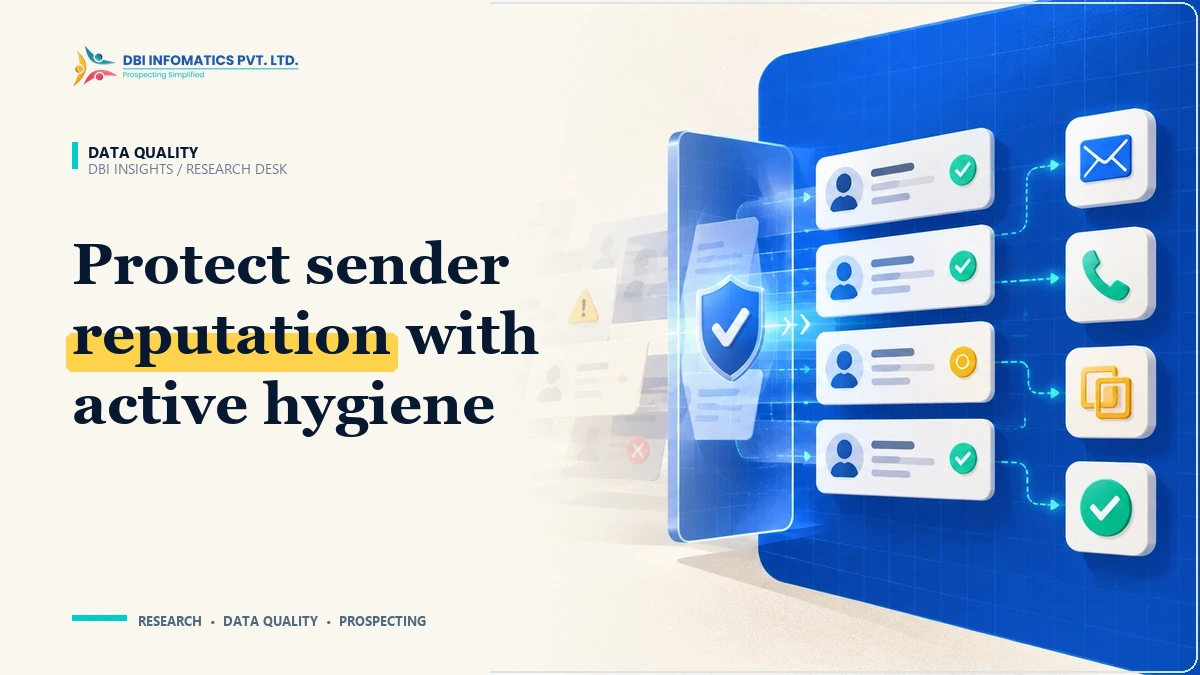
- Human verification payoff: Pre-validating mailboxes with human syntax, MX record checking, and verified LinkedIn tenure lowers bounces below 1%.
The Deliverability Crisis: Why Outbound Emails End Up in Spam
In 2024 and 2026, major email service providers—including Google, Microsoft, and Yahoo—introduced strict enforcement standards for bulk senders. Domains sending cold outreach with hard bounce rates exceeding 2% to 3% now experience immediate inbox placement penalties, throttling, or outright domain blacklisting.
Many sales teams mistakenly believe that warming tools and copywriting tweaks can bypass spam filters. In reality, data quality is the foundational pillar of email deliverability. If your prospecting lists contain defunct email addresses, outdated personnel, or unmonitored mailboxes, all the email copy optimization in the world cannot rescue your domain reputation.
The Anatomy of Email Decay: Hard Bounces and Spam Traps
Email decay manifests in three distinct hazards that severely degrade your sender score:
- Hard Bounces (User Unknown): Occur when an employee departs and the company deletes the mailbox. ESP algorithms interpret sudden spikes in 550 User Unknown errors as careless spam activity.
- Recycled Spam Traps: Old corporate email addresses acquired by anti-spam organizations (like Spamhaus). If you email an address that has been inactive for 12 months, you are identified as a scraper using stale, unverified lists.
- Catch-All Server Vulnerabilities: Many enterprise mail systems (such as corporate Exchange servers) accept all incoming mail at the SMTP handshake stage to prevent directory harvesting, only to discard or bounce the message post-delivery.
| Verification Layer | Standard API Verifiers (NeverBounce, ZeroBounce) | Human-in-the-Loop Multi-Stage Hygiene (DBI) |
|---|---|---|
| Catch-All Domain Handling | Labels as 'Risky' or 'Unknown' without resolution | Researches live company email patterns, cross-references recent replies |
| Personnel Departure Detection | Fails if mail server redirects or silently drops | Verifies current employment status on LinkedIn and corporate site |
| MX & DMARC DNS Analysis | Automated ping only | Full verification of SPF, DKIM, DMARC, and mail-exchanger health |
| Expected Bounce Rate | 3% to 7% (often spikes above safety thresholds) | Strictly under 1.5% across cold outbound cadences |
| Rep Impact | Sales reps waste time guessing if 'Risky' emails work | Clean, 100% send-ready contact list ready for sequencer upload |
Why Automated SMTP Pingers Are No Longer Enough
Traditional list verification tools rely on simulated SMTP handshakes (EHLO > MAIL FROM > RCPT TO). Modern security gateways like Proofpoint, Mimecast, and Barracuda actively defend against these pings. When an automated verifier tests 500 emails at an enterprise company, the gateway detects the probe and flags the test IPs or returns false positives.
To safely verify enterprise decision-makers at Fortune 500 accounts, data teams must blend digital syntax checks with contextual human research: checking recent company publications, webinar panels, author bylines, and organizational hierarchy trees.
The 5-Step Pre-Send List Hygiene Protocol
Before uploading any prospect list into HubSpot, Apollo, or Salesloft, run this 5-step hygiene protocol:
- Domain Normalization: Strip tracking strings, remove leading/trailing whitespaces, and normalize subdomains to primary apex domains.
- Syntax & Role-Account Filtering: Eliminate role accounts (info@, sales@, support@, admin@) that drag down engagement rates.
- DNS & MX Server Validation: Check that the target domain has active Mail Exchange records and has not expired or moved to a parked landing page.
- Employment & Seniority Confirmation: Confirm the contact is still actively working at the company within the current quarter.
- Cadence Throttling: Cap sequence volume per inbox to under 40 cold emails per day to avoid sudden velocity spikes.
Frequently Asked Questions
What is considered an acceptable bounce rate for B2B cold email?
For cold outbound sales, your hard bounce rate should remain strictly below 2%. If your bounce rate exceeds 3%, email providers will throttle your delivery, and exceeding 5% risks immediate account suspension.
Why do automated verifiers label so many emails as 'Catch-All'?
A catch-all (or accept-all) configuration means the server accepts messages for any address @company.com to avoid revealing whether an employee exists. Automated verifiers cannot determine if the specific mailbox is real without specialized research.
How often should an enterprise CRM contact list be cleansed?
Active prospecting lists should be validated before every new outreach campaign. The broader CRM database should undergo deep hygiene every 90 days to retire dead records before automated sequences touch them.
Need to operationalize this for your pipeline?
DBI Infomatics builds custom research, continuous enrichment, and verification workflows tailored to your specific account tiers and CRM schemas.
Talk to the DBI Research Team →