

 DBI Infomatics Research Desk
At a glance
- The fragmented account dilemma: In unmapped CRMs, a global conglomerate like Alphabet, Siemens, or Tata often exists as 40+ disconnected accounts worked by separate reps.
- Pricing & discount conflicts: Without parent-child visibility, sales teams inadvertently quote conflicting discount structures to different divisions of the same holding company.
- The Global Ultimate Owner (GUO): Mapping the Ultimate Beneficial Owner allows revenue leaders to negotiate enterprise-wide Master Services Agreements (MSAs).
- Cross-selling acceleration: Closing a single subsidiary provides warm executive referrals and procurement pre-approval across dozens of sister operating companies.
The Conglomerate Chaos: Why Enterprise CRMs Fracture
When B2B sales teams pursue large enterprise accounts, they rarely sell to a single, monolithic corporate entity. Enterprise organizations operate through dozens—sometimes hundreds—of legally registered operating companies, regional joint ventures, and acquired subsidiaries.
Without structured corporate hierarchy mapping, your CRM becomes a chaotic tangle of fragmented records. One sales rep prospects an operating division in Germany, another rep emails a subsidiary in Singapore, while a strategic account executive is negotiating an enterprise agreement at corporate headquarters in New York. The result is internal rep conflict, embarrassing customer interactions, and missed enterprise contract expansion.
Deconstructing Corporate Trees: GUO, DHO, and Operating Subsidiaries
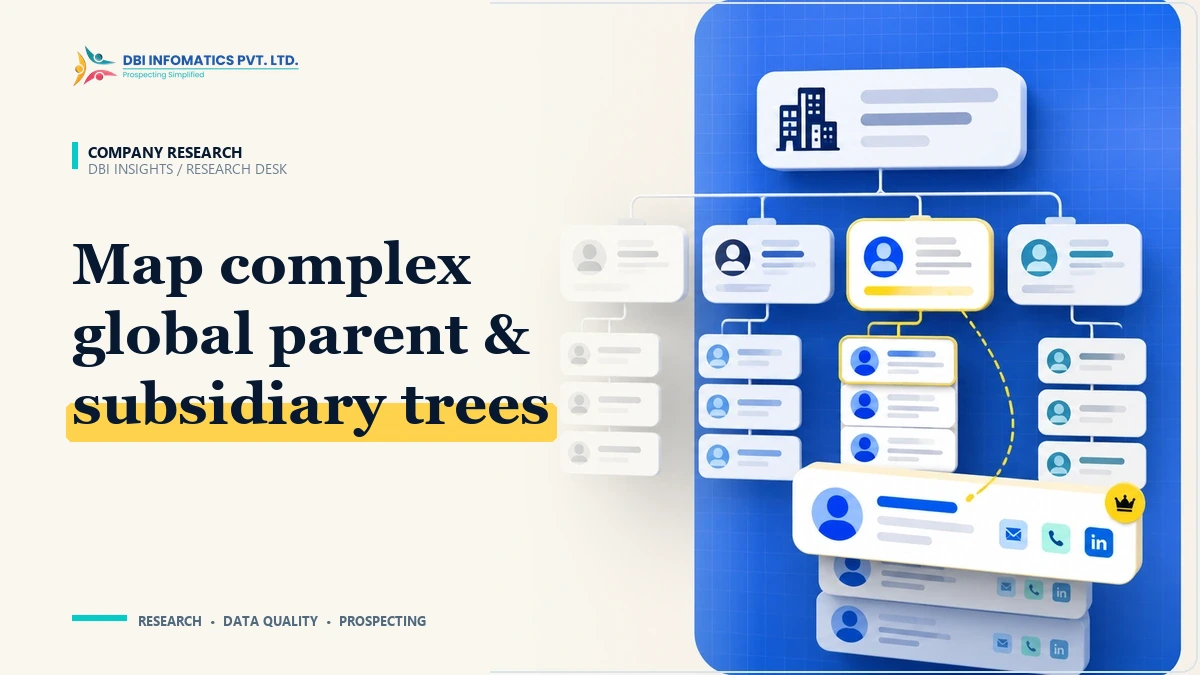
An enterprise corporate hierarchy consists of three critical legal layers:
- Global Ultimate Owner (GUO): The apex holding entity that exercises ultimate voting and financial control over the entire conglomerate tree (e.g., Berkshire Hathaway, Alphabet Inc., Tata Sons).
- Domestic Holding Organization (DHO): The highest-level operating entity within a specific sovereign jurisdiction (e.g., Tata Consultancy Services Ltd in India, Siemens USA in North America).
- Operating Subsidiaries & Business Units: Autonomous legal entities registered for specific product lines, brand assets, or regional operations that hold distinct procurement authority.
| Operational Dimension | Flat / Unlinked Account Records | Structured Corporate Hierarchy Trees (DBI) |
|---|---|---|
| Sales Territory Conflict | High: Reps unknowingly poach sister accounts from colleagues | Zero: Account ownership flows logically from Global Parent rules |
| Enterprise MSA Leverage | Low: Selling isolated $20k deals without centralized leverage | High: Consolidates regional deals into multi-million dollar MSAs |
| Total Account Spend Visibility | Fragmented deal history scattered across 30+ separate accounts | Consolidated rollup showing complete lifetime contract value |
| Credit & Solvency Analysis | Evaluates subsidiary in isolation, missing parent guarantees | Reviews corporate balance sheets and parent credit backing |
| Rep Prospecting Velocity | Rep must manually investigate corporate ownership online | Complete visual hierarchy tree mapped directly inside the CRM |
The 4-Step Corporate Hierarchy Mapping Framework
Building clean enterprise corporate trees requires rigorous data operations:
- Statutory Entity Identification: Sourcing official registration numbers (CIN, LEI, DUNS) across global corporate registries to confirm legal ownership stakes.
- Ownership Percentage Thresholds: Defining ownership rules (e.g., requiring >50.1% equity voting share for formal parent-child linking).
- CRM Parent-Child Re-parenting: Establishing relational Parent Account fields in Salesforce or HubSpot to enable automated rollup reporting.
- Brand-to-Entity Cross-Referencing: Linking consumer-facing trade brands to their correct statutory parent entities.
Unlocking Land-and-Expand Enterprise Revenue
The fastest path to enterprise revenue growth is not cold outbound to strangers—it is expanding into sister operating units of existing happy customers. With clean corporate hierarchy data, account managers can identify every sister subsidiary and leverage existing vendor approval status for frictionless expansion.
Frequently Asked Questions
What is the difference between a brand name and a legal parent entity?
A brand name is a commercial trade mark used for marketing (e.g., Instagram or YouTube). The legal parent entity is the registered corporate corporation (Meta Platforms, Inc. or Alphabet Inc.) that signs contracts and pays invoices.
How does hierarchy mapping prevent sales rep territory disputes?
By establishing a 'Parent Account Rule' where all subsidiaries are assigned based on the geographic headquarters of the parent entity or distributed cleanly via regional operating units.
What global corporate registers does DBI utilize for hierarchy mapping?
DBI researchers utilize MCA (India), Companies House (UK), SEC EDGAR (US), LEI (Legal Entity Identifier) databases, and official annual shareholder reports to confirm statutory ownership chains.
Need to operationalize this for your pipeline?
DBI Infomatics builds custom research, continuous enrichment, and verification workflows tailored to your specific account tiers and CRM schemas.
Talk to the DBI Research Team →