

Better data for better prospecting.
DBI Infomatics helps sales, marketing and research teams turn clear audience requirements into structured company and contact datasets — researched, enriched, validated and ready for the next workflow.
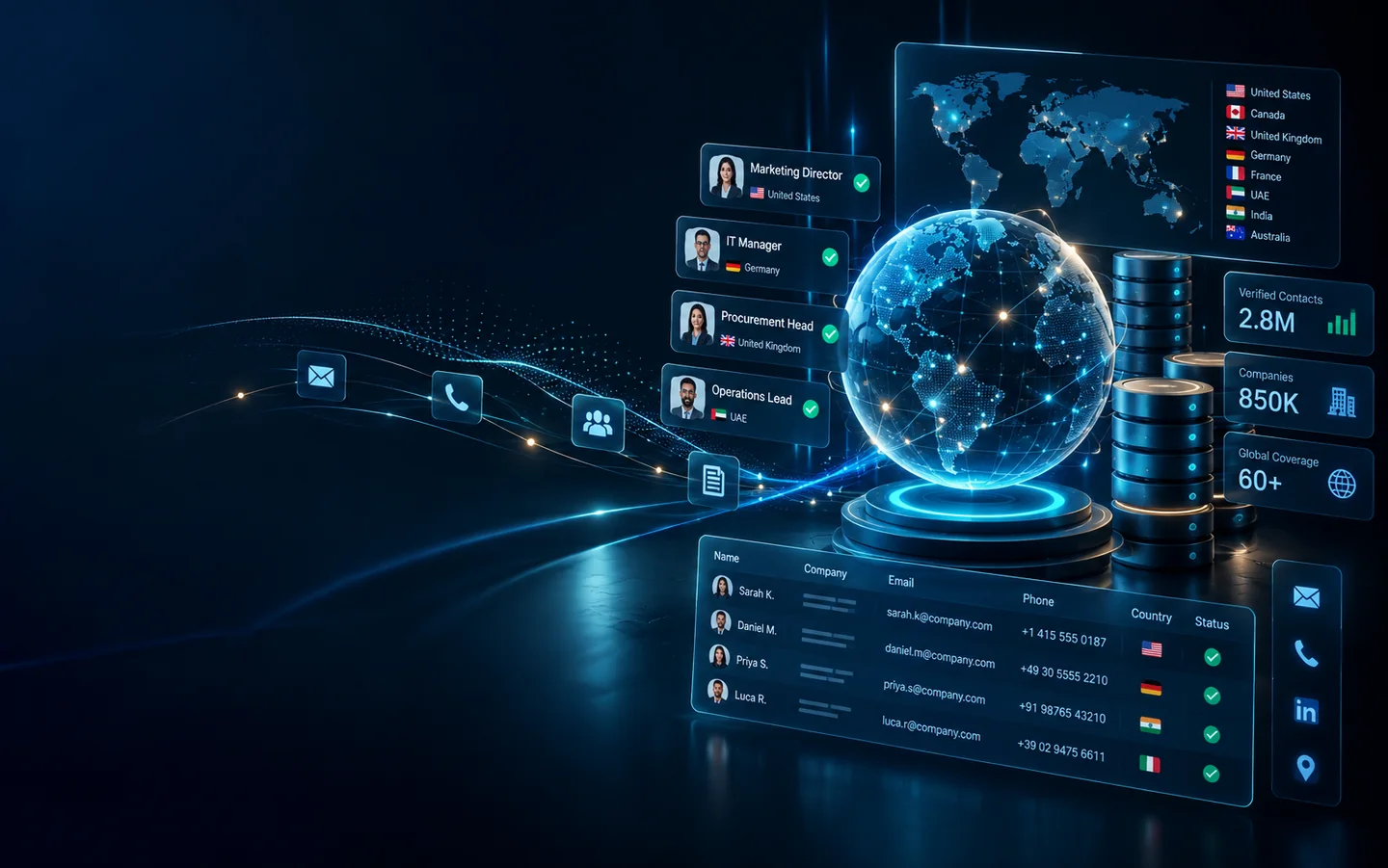
One connected workflow. Eight useful capabilities.
Start with a narrow brief or a wider market question. The work can move from targeting and research through enrichment, validation and delivery without losing the structure.
Lead generation backed by research, not guesswork.
Build focused account and contact lists around defined industries, company types, geographies, job functions and other audience criteria.
B2B Lead Generation
Target the right companies and decision-makers around clear audience rules.
Database Building
Create structured company and contact datasets around your ICP.
Data Enrichment
Complete missing business and contact fields with relevant context.
Data Validation
Apply project-defined checks for relevance, format, completeness and consistency.
Company Research
Research company profiles, offerings, industries, locations and business facts.
Vertical Market Research
Map industries, sectors, niches and served-market signals.
Digital Marketing
Support campaigns with research-backed audiences and content inputs.
Web Development
Build polished digital experiences that clarify the data story.
From audience idea to sales-ready dataset.
Good data projects become easier to manage when the steps are visible. DBI keeps the flow straightforward: define the brief, research the market, check the records and return the result in a usable shape.
Translate the audience into clear rules, fields and output expectations.
Investigate companies, roles, markets and other agreed data points.
Apply the project checks that matter before handoff.
Return structured records ready for review or downstream use.
Put the context beside the contact.
A useful research record brings company context, role, contact information and status together so the next step is obvious.
Built around the teams that use the data next.
Different teams ask different questions. The research layer changes with the brief while keeping the structure consistent.
Sales teams
Find the companies and roles that match the territory, market and ICP you are working against.
Research that adapts to the market you are targeting.
Use industry, geography and business context together rather than forcing every market into one generic list.
Technology & Software
SaaS, software, IT services, cloud and cybersecurity.
Financial & Business Information
Research, information services, finance and business intelligence.
Healthcare & Life Sciences
Healthcare organisations, pharma and life-science ecosystems.
Manufacturing & Industrial
Industrial, engineering, equipment and production-led profiles.
Professional Services
Consulting, agencies, advisory, legal, accounting and specialists.
Media & Publishing
Publishers, media companies and audience-led organisations.
Telecommunications
Operators, service providers and communications technology.
Logistics & Transportation
Freight, logistics, mobility, shipping and transportation.
Just some of the great customers we work with





A global research mindset with practical output structure.
Coverage can be shaped by country, region, company profile, role, industry, vertical or other project-defined criteria.
Practical perspectives on B2B data work.
Why B2B datasets decay — and where the cleanup should start.
Role changes, domain changes, duplicates and field drift rarely appear all at once. A repeatable workflow catches the issues closer to the point of use.
Read insight →How to write an ICP brief a data team can actually use.
Turn broad audience language into rules that can be researched, checked and delivered.
Read →Which fields should be reviewed before upload?
A compact operational checklist for dataset handoffs.
Read →