

 DBI Infomatics Research Desk
At a glance
- Self-reported inaccuracies: LinkedIn profiles are self-authored resumes; over 30% of users fail to update their profile for months after leaving an employer.
- Missing direct contact data: Sales Navigator does not provide verified corporate email addresses or direct dial phone lines, requiring third-party matching tools that introduce errors.
- Invisible traditional markets: In manufacturing, logistics, defense, and healthcare, top procurement heads and executives maintain dormant or non-existent social profiles.
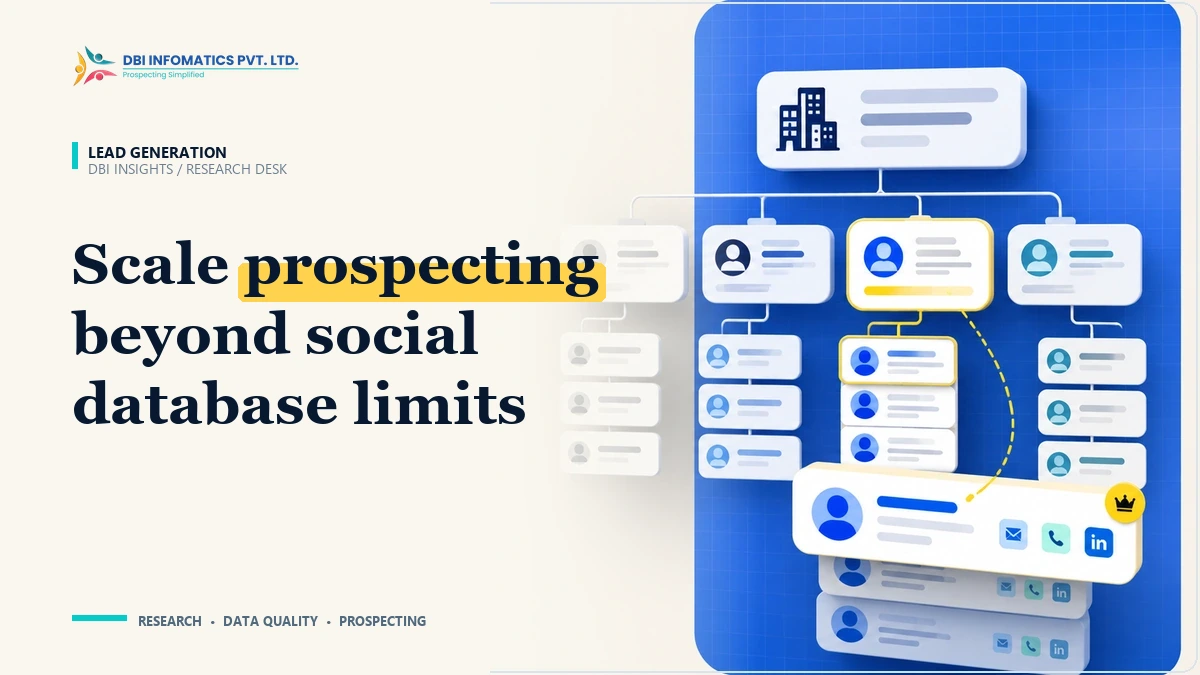
- Account hierarchy blindness: Sales Navigator cannot map parent-subsidiary corporate relationships, causing reps to pitch subsidiaries as independent companies.
Four Structural Blind Spots in Social Data Mining
Revenue leaders who audit their Sales Navigator pipelines consistently discover four critical failure modes:
- Lagging Departure Data: Employees who depart an organization often keep their former company listed for months while searching for their next role, resulting in SDRs pitching phantom executives.
- Vanity Titles vs. Real Budget Authority: A 'Director of Strategic Partnerships' might be an individual contributor with zero purchasing power, while a quiet 'General Manager' controls a $20M budget.
- Zero Verified Direct Connectivity: Sales Navigator provides InMail—a channel with dwindling open rates. Converting a profile into an actionable outbound record requires guessing email patterns and switchboard dialing.
- Omission of Regulated & Traditional Sectors: Leaders in defense manufacturing, private wealth management, and industrial distribution deliberately minimize their social media footprints for security and confidentiality reasons.
| Prospecting Attribute | Automated Sales Nav Scrapers (PhantomBuster, Evaboot) | Dedicated Desk Research Operations (DBI) |
|---|---|---|
| Employment Currency | Relies on user's last profile update (30%+ stale) | Cross-verified against live corporate team pages and press releases |
| Direct Dial Accuracy | Guessed from generic algorithm phone tables (10–15% connect) | Verified direct extensions and corporate mobile lines (15–20% connect) |
| Corporate Tree Context | Flat account lists; ignores holding companies and subsidiaries | Structures complete parent-subsidiary organizational trees |
| Executive Scope | Limited to active social media users | Uncovers offline decision-makers through trade rosters and filings |
| Account Relevancy | Produces high volumes of unqualified individual contributors | Curated, multi-threaded buying committees for Tier-1 ABM plays |
The Multi-Source Corporate Research Stack
To build a resilient enterprise pipeline, DBI Infomatics combines social signals with verified external registers: Ministry of Corporate Affairs (MCA) filings in India, Companies House in the UK, SEC disclosures in the US, patents, trade association rosters, and press releases. This multi-source synthesis guarantees that every account record represents an active, verified commercial entity.
Finding Decision-Makers Who Don't Post Online
The highest-value enterprise buyers—VP of Procurement, Plant Managers, Chief Risk Officers—rarely publish content on social networks. Identifying them requires investigative desk research: parsing conference brochures, regulatory approval filings, and vendor accreditation pages where their names appear officially.
Frequently Asked Questions
Should sales teams stop using Sales Navigator entirely?
No. Sales Navigator is excellent for initial talent discovery and monitoring career transitions. However, it should serve as a discovery starting point rather than your final unverified prospect database.
Why do third-party email finders fail on Sales Navigator leads?
Email finders use predictive algorithms (e.g., first.last@company.com). If a company uses non-standard email syntaxes, nicknames, or has recently migrated email domains, predictive tools produce 40%+ bounce rates.
How does human desk research verify an executive's employment status?
DBI researchers check corporate press announcements, official company about pages, recent webinar panels, and perform real-time SMTP handshakes to ensure the executive is actively drawing a salary and receiving mail at the organization.
Need to operationalize this for your pipeline?
DBI Infomatics builds custom research, continuous enrichment, and verification workflows tailored to your specific account tiers and CRM schemas.
Talk to the DBI Research Team →